
This article initially appeared in a print edition of the Hilltop Monitor published Oct. 6, 2025.
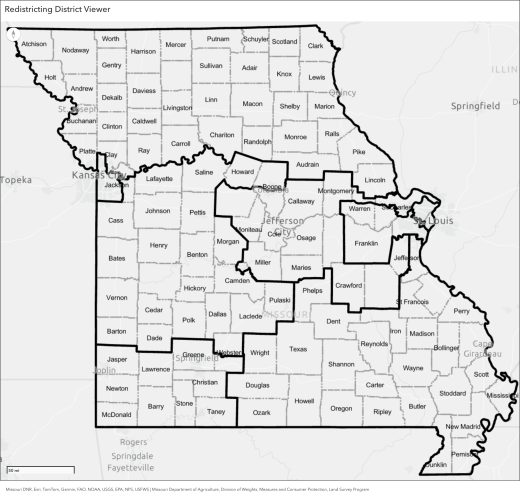
America is currently experiencing an unprecedented wave of mid-decade redistricting. As of September of 2025, eleven states, including Missouri, have made some progress towards redrawing their electoral boundaries for the 2026 elections, and Missouri joins Texas in having officially signed a new district map into law. Barring the potential of a lawsuit overturning the map, many Missouri voters, particularly those around Kansas City, will find themselves in a new electoral district in 2026, and those changes are likely to force Democratic representative Emanuel Cleaver out of his seat.
Missouri’s Redistricting Plan and House Bill 1
Missouri’s redistricting effort can be found in Missouri House Bill 1 of the 103rd General Assembly’s second extraordinary session (HB1). HB1 is a lengthy bill, assigning every voting district and county in the state of Missouri to one of eight electoral districts, but the key changes proposed in the bill can be found by comparing the new district map to the prior map, approved for use in 2022.
Both maps have eight electoral districts, but the shape of several districts, particularly District 5, have been changed. Where District 5 used to contain most of the Kansas City area and nothing else, it now extends several hundred miles into rural (and reliably Republican) central Missouri. The north and south ends of the city have been placed in districts 6 and 4 respectively, which each also cover an extensive region of rural Missouri. The result is that district 5, currently held by long-serving Democrat Emanuel Cleaver II, will now lean Republican, leaving only one Democrat-leaning district in the state.
Governor Mike Kehoe signed HB1 after it cleared the state legislature, officially enshrining the new electoral map into Missouri law. However, its path forward has become fraught. Four lawsuits (at time of writing) have challenged the bill’s legality, with most emphasis being placed on the compactness (or lack thereof) of the new fifth district and the fact that the state constitution does not permit mid-cycle redistricting. Emanuel Cleaver has also promised a lawsuit if HB1 passes, so it is likely that more lawsuits are still to come.
The fate of HB1’s new electoral map will therefore depend on the decisions of several courts, and it is likely that, whatever the outcome of the initial trials, every verdict will be appealed up through the courts.
The National Rise of Redistricting
Missouri’s redistricting effort is part of a broader effort by both political parties to create new House seats for their respective party for the upcoming 2026 midterm elections. President Trump has pushed Republican-led states to create more Republican-leaning districts, concerned that midterm election results will swing against Republicans. In the 23 midterm elections since 1934, the president’s party has lost House seats in all but three elections; Republicans currently hold a six-seat majority with three vacant seats, so any lost seats in the midterms may end the Republican Party’s control of the chamber.
In response to Republican efforts to gain more seats in Texas, Missouri, and elsewhere, Democratic state governments have proposed their own retaliatory redistricting efforts. California Governor Gavin Newsom has taken the lead in this effort, proposing a new map that would likely swap six currently-red seats to Democrats in 2026. California’s proposition 50 is slated to arrive at the polls in November, with California citizens voting directly on whether to approve the map. Current polling indicates that the California public supports the measure, 51% to 34%, but there is still over a month before votes will be cast. Similar “reactive” redistricting has been planned in other Democratic-led states such as Maryland, but has seen somewhat limited success outside of California.
With both political parties pushing partisan redistricting, a grassroots campaign to limit redistricting has gained steam. Groups such as Common Cause have been fighting to prevent partisan redistricting and leading anti-gerrymandering protests, particularly in Republican-led states such as Indiana. Even in California, opinions are split on Proposition 50’s “reactive” redistricting, with 49% of survey respondents believing Prop 50 to be a bad thing, including 13% of those who are voting for it and 96% of those who oppose it.
Polling in Missouri shows that voters are against House Bill 1’s redistricting plan, though the margins in Missouri are significantly narrower. A Democratic Party poll finds that 48% of Missouri voters oppose the redistricting move, while 37% approve of it. Missouri voters have also attempted to force a statewide referendum on the vote (similar to California’s upcoming Prop 50 vote), which is in the early stages of collecting signatures. Even with Governor Kehoe signing HB1 on September 28th, the array of lawsuits and attempts to demand a popular referendum on redistricting leave the future of Missouri’s congressional district lines murky at best.
For those interested in redistricting, particularly in Missouri, Jewell and Pi Sigma Alpha will be hosting a panel discussion on gerrymandering on October 15th at 6:30 pm.