
This article initially appeared in a print edition of the Hilltop Monitor published on Oct. 6, 2025.
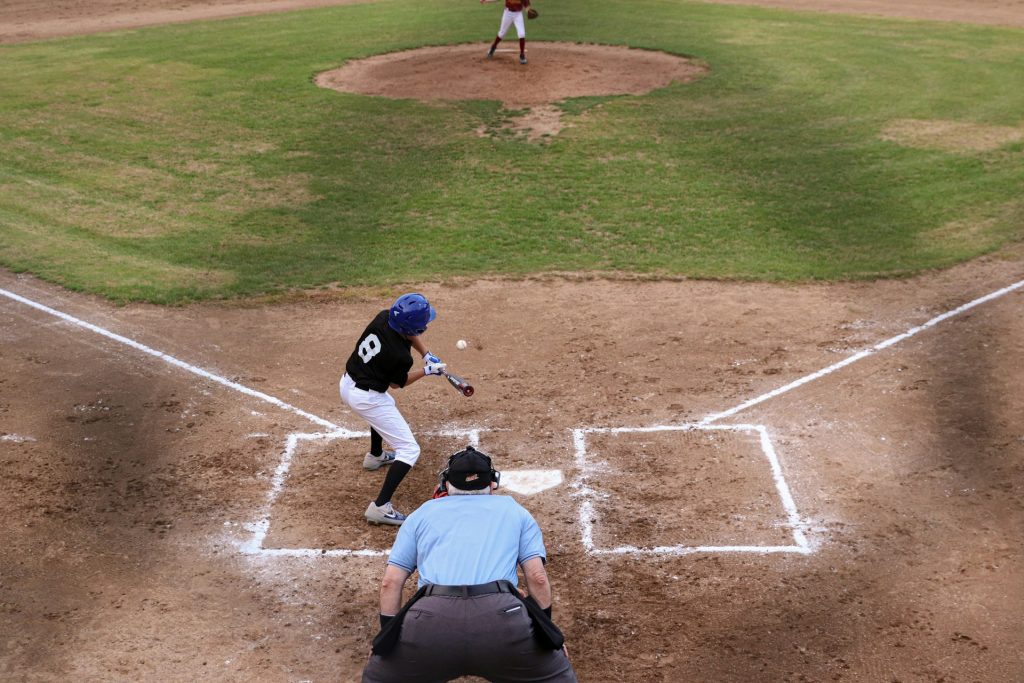
On Sep. 23, Major League Baseball (MLB) announced that it will be bringing Automated Balls and Strikes (ABS) technology to all its ballparks and games beginning with the 2026 season. But what is this technology? Is it new? In this article, we’ll break down MLB’s new ABS system, explaining what it is, how it works and how we got here.
What is ABS?
ABS uses twelve cameras placed around the ballpark to triangulate the position of every pitch as it travels from the pitcher to the catcher. Once the human umpire calls the pitch a “Ball” or a “Strike,” the pitcher, batter or catcher can challenge the call. They must do so by tapping their helmet and must do so immediately (untimely challenges are rejected).
Once that happens, the stadium waits in anticipation as a computer graphic shows where the pitch was located in the strike zone. If the original call was correct, the challenging team loses one of the two challenges they get throughout the course of the game. If the original call was incorrect, the call is reversed and the team retains its challenge (similar to the challenge process in most other sports).
Since teams only get two unsuccessful challenges per game, players are incentivized to use them on obviously incorrect calls where there is a high chance the challenge will be returned. This introduces a new element of strategy to the game: it’s probably not worth it to challenge borderline pitches unless the game situation demands it.
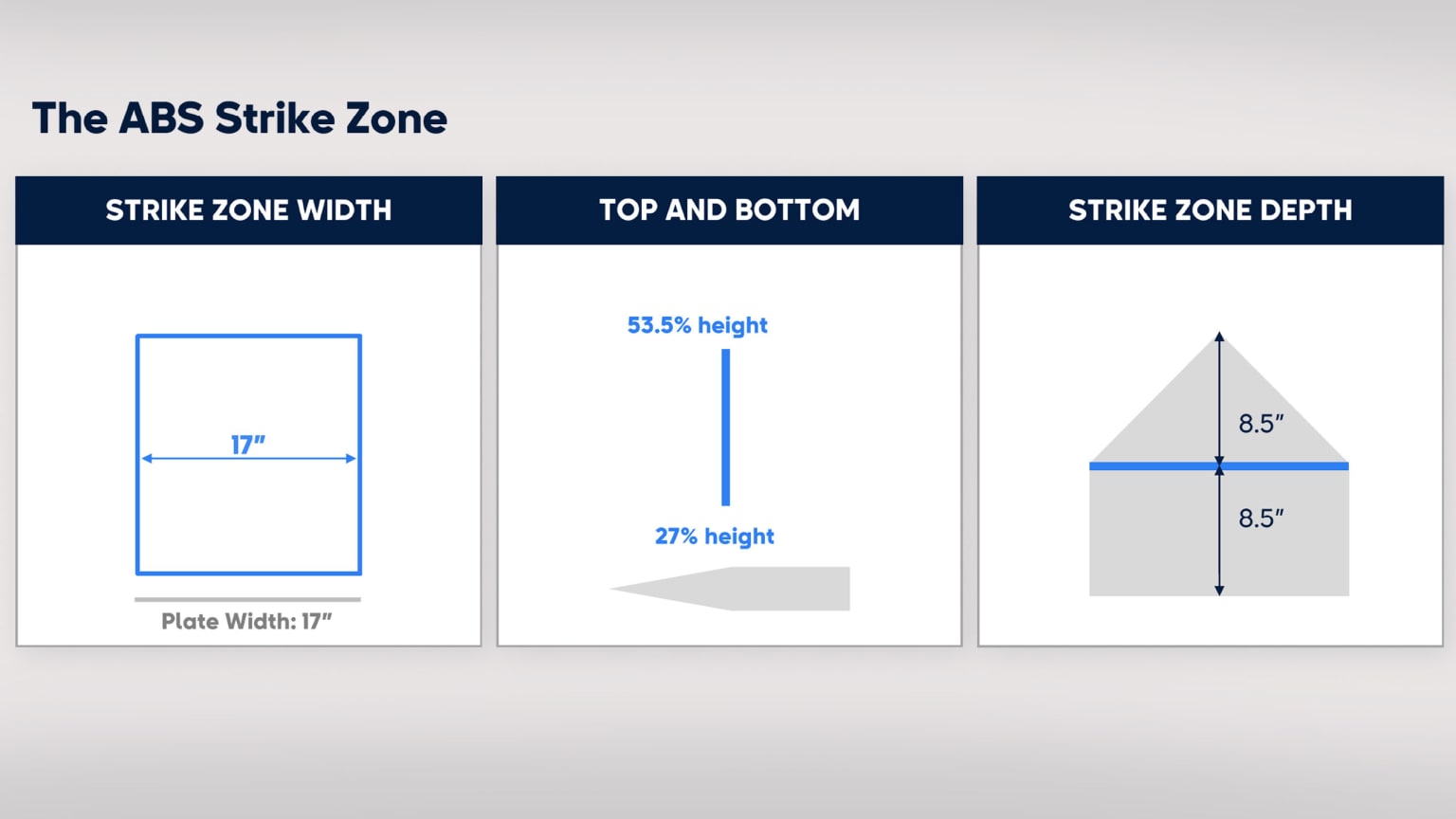
To make ABS possible, MLB had to change the way the strike zone worked. Pre-ABS, the strike zone was the width of the plate and extended vertically from the batter’s knees to the midpoint between their shoulders and the top of their pants. (Umpires, especially at lower levels, commonly use the bottom of the letters on a team’s uniform as an approximation). Now, the zone is determined by a batter’s height. If any part of the ball crosses the plate between 27-53.5% of a batter’s height (before they settle into their batting stance), the pitch will be called a strike.
How did we get here?
Originally, ABS was tested in the independent Atlantic League in 2019, where it encountered mixed success. Issues with the technology meant that pitches that bounced before crossing the plate registered as strikes, though human umpires would (and did) overrule the system. Then-Atlantic League president Rick White said that he was “relatively confident that [robot umpiring was] going to spread through organized baseball,” which it did several years later.
The challenge system we see today was first proposed in October 2019 by Lindsay Imber and Tim McCaffrey of Close Call Sports. In their article, Imber and McCaffrey proposed the system MLB would eventually adopt, advocating for a compromise between the traditionalist no-computers-allowed approach and the Atlantic League’s replace-humans approach. They note that “technology can assist in the ball/strike call mission,” while also acknowledging “that the very system baseball presently uses… is prone to error.”
Since their article, MLB’s HawkEye technology has improved from a two-inch margin of error to a half-inch margin of error.
This reduced margin of error has enabled ABS to find practical use in high-level baseball. In 2023, Minor League Baseball (MiLB) and Triple-A teams tested both the no-humans-allowed approach and the challenge system (though teams were permitted three challenges each instead of the present two). By the end of 2024, MiLB had determined that the challenge system was better and adopted it. In 2025, MLB adopted the technology for Spring Training games and the All-Star Game. In 2026, the technology will be adopted for the full MLB season.
ABS and broader ball-tracking technology represents an exciting development for baseball. As an umpire, I’m excited for the future of ABS (even though there’s a chance it takes my job). While technology’s uncertainty means the human aspect of officiating is still necessary, technology can help us correct for human error on close calls. The ABS challenge system seems like a great way to do this for baseball.
