
The shooting of right-wing commentator Charlie Kirk shocked people on all sides of the political spectrum. Whether one agrees with Kirk’s politics or not, the attack served as a disturbing reminder that violence is becoming an alarmingly common part of our political environment.
But incidents of political violence don’t exist in a vacuum. They’re part of a much larger and more dangerous trend. And while it’s easy to focus only on high-profile moments of violence, this crisis runs deeper than any one person, party, or ideology.
To fully understand what’s happening, we need to take a step back and ask: What is political violence, really? Where is it coming from? And why has it become such a prominent force in American life?
What Is Political Violence?
Political violence is the deliberate use of force or harm to achieve political objectives. It occurs when individuals or groups use physical aggression, intimidation or destruction to influence power structures, policies or social order. This can includes armed uprisings, terrorism, assassinations, voting intimidation or violent protests. What sets political violence apart from ordinary violence is its intentions; it is motivated by political aims rather than personal gain or individual disputes. Because it seeks to shape or maintain systems of power through fear and force political violence often destabilizes societies and deepens political conflict.
A Sharp Increase Since 2016
The problem of political violence in the U.S. didn’t begin in 2016, but that year marked a turning point as the presidential campaign and success of President Trump marked a change to the America public; the political climate became more divided, more angry, and more hostile. As extremist rhetoric gained ground in mainstream politics, acts of political violence began to rise.
The events speak for themselves:
In 2017, a white supremacist drove his car into a crowd of anti-racist protesters in Charlottesville, killing Heather Heyer. In addition, Steve Scalise, the then Republican Minority House Whip, was shot during practice for the Congressional baseball game.
In 2018, 11 people were murdered in a mass shooting at the Tree of Life synagogue in Pittsburgh, the deadliest attack on Jews on American soil.
In 2019, a gunman targeting immigrants killed more than 20 people in a Walmart in El Paso, Texas, after posting a white nationalist manifesto online.
On January 6, 2021, rioters stormed the U.S. Capitol in an attempt to overturn the results of a fair, democratic election. At least seven people lost their lives in connection with the attack.
In 2022, a white supremacist killed 10 Black people at a Buffalo, New York supermarket, motivated by racist conspiracy theories.
In 2023, Paul Pelosi, husband of then-House Speaker Nancy Pelosi, was brutally attacked in his home by an intruder seeking to harm the Speaker, citing political grievances.
In 2024, Donald Trump was the target of an attempted assassination at a campaign rally in Butler, Pennsylvania.
As Louis Jacobson and Amy Sherman point out in the article, How recent political violence in the U.S. fits into ‘a long, dark history’:
“In 2025 alone, Minnesota Democratic state Rep. Melissa Hortman and her husband were fatally shot; an arsonist set fire to the Pennsylvania governor’s residence with Democratic Gov. Josh Shapiro and his family inside; an Immigration and Customs Enforcement officer was shot and injured outside a detention facility in Texas; the New Mexico Republican Party headquarters was set on fire; and a shooter attacked the Centers for Disease Control and Prevention headquarters.”
These were not random acts of violence; they were political acts, driven by ideology and fueled by misinformation, hate and fear. And they’re not isolated either. In recent years, political threats against elected officials have skyrocketed. Armed groups have shown up at protests and polling stations. Voter intimidation is back in the headlines.
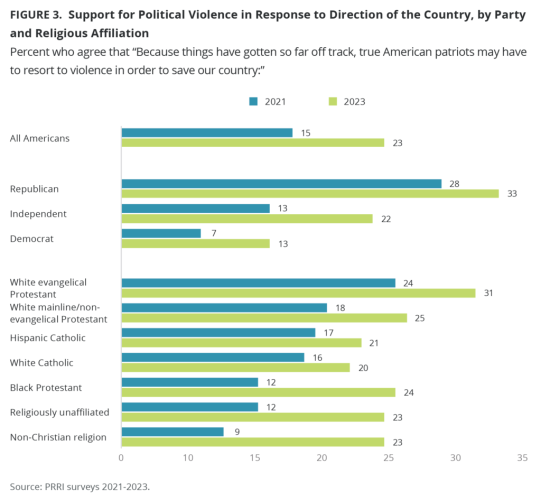
What we’re seeing is a shift in political norms. The american public is more likely to supporting the breaking the “rules” of democracy and political violence is increasingly viewed as a legitimate tool in political conflicts.
Guns Make It All More Dangerous
In no other wealthy country is this trend of political violence more deadly than in the United States, and that’s because of one defining factor: gun. While it is true that there are many factors leading to a rise in political violence, the number of fatalities is unique to America.
America’s deep-rooted gun culture means that political violence here isn’t just loud—it’s lethal. In an already polarized climate, widespread access to firearms turns heated disagreements into potential battlefields.When armed groups show up to polling places or rallies, it’s no longer just speech, it’s intimidation. And when people with extreme views believe they have both a cause and the firepower to fight for it, innocent lives are often caught in the crossfire.
The United States has far greater access to firearms than any other country. In fact, the United States is the only country where civilian guns outnumber people. This creates a unique cultural of gun violence, “In 2023, 46,728 people died by firearms in the United States — an average of one death every 11 minutes.” The connection is simple: the easier it is to access guns, the deadlier political violence becomes.
Why It Matters and What We Can Do
It’s easy to feel overwhelmed or helpless in the face of rising political violence. But apathy will solve nothing. We, as American citizens, have an obligation to protect the democratic norms that keep people safe. This means questioning what we see in the media, holding leaders accountable for their words and actions, and rejecting ideologies that dehumanize others. It means understanding that democracy cannot survive if people believe violence is the only way to be heard.