
Every Olympics has their highlights, golden moments and scandals leaving speechlessness. The 2026 Winter Olympic Games are no different. Based in Milan and Cortina d’Ampezzo, Italy, the two-week non-stop competitions brought widespread smiles, tears, gasps and gossip. As they have come to an end, let’s recap.
Medal counts
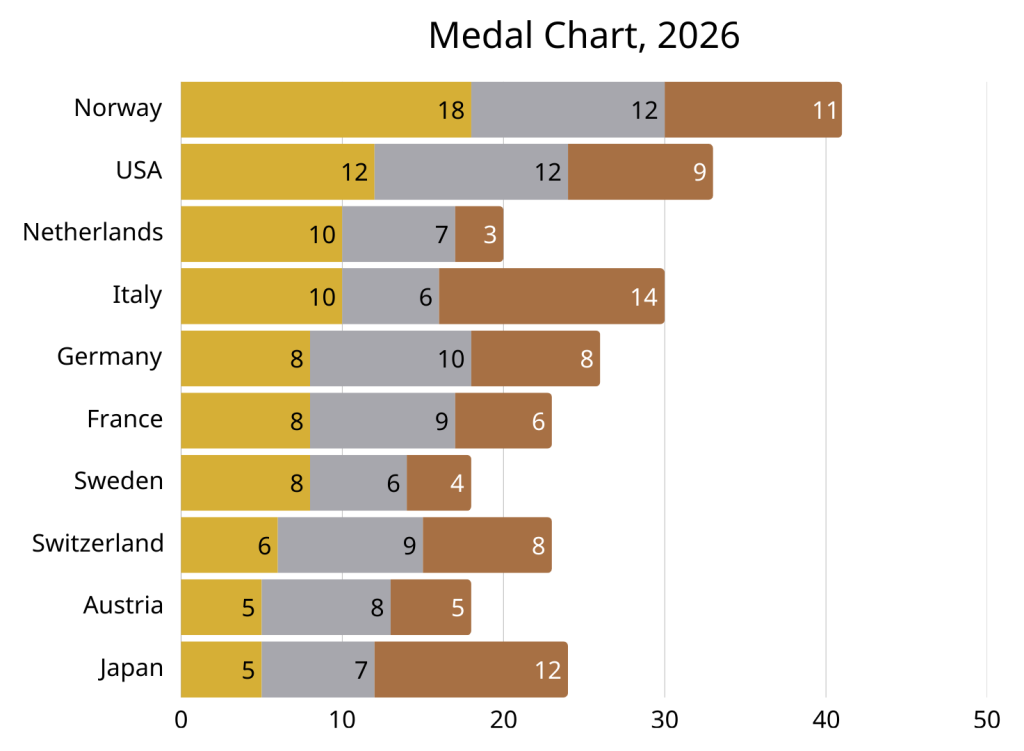
For a fifth straight Winter Games, Norway topped the medal chart with 41 total medals, of which 18 were gold—the most ever won by a nation at the Winter Games. America came second with twelve gold medals and 31 total medals, a national record.
The U.S. took several high-profile gold medals, especially in figure skating and ice hockey. The U.S. men’s hockey team won a nailbiter against Canada 2-1 in overtime in a shocking upset, as did the U.S. women’s team in what NBC calls a “storybook ending” to skip Hilary Knight’s Olympic career. Elsewhere on the ice, U.S. figure skaters shone, with standout performances by “Quad God” Ilia Malinin and Alysa Liu, who both brought home a gold medal.
(Side note: if you’ve not watched Alysa Liu’s long routine, you are missing out. She is so infectiously happy.)
Other strong performances came from the Netherlands and host nation Italy, both winning ten gold medals.
Public Infidelity
Norwegian biathlete Sturla Holm Laegreid shocked viewers when he publicly admitted to cheating on his girlfriend. The affair happened three months into their relationship, and after coming clean shortly before he took the world’s snow-covered stage, he stated that he wanted to set the record straight after he had “nothing to lose.” Not long after his confession, his ex, whose name has been disclosed, reported that Laegreid’s actions are “hard to forgive.” She “did not choose to be in this position and it hurts to have to be in it,” despite it being Laegreid’s “biggest mistake” of his life.
Condom Shortages
Safe to say Laegreid will not be in need of the complementary condoms the Olympics graciously hands out. But even if he was, the shortage would postpone him anyway. Entering the 2026 season, Olympic officials had 10,000 condoms distributed for the 2,800 athletes competing; an average of only 3.5 condoms per athlete. Desperation only increased with Valentine’s Day hitting right in between the Winter schedule, where lovebirds, flings and medal highs all clash together.
This is not out of the ordinary for the Olympics, however. In the 1992 Winter Olympics, 30,000 condoms were dispersed, and 70,000 in 2000, where there had to be an emergency delivery of another 20,000. In 2002, while hot tubs were provided for use, they were quickly retracted after many used them for sexual pleasure; 100,000 were given out that year. 130,000 condoms, with an additional 30,000 packets of lube, were available for athletes in the Summer Olympics of 2004, and in 2012, 150,000 were ordered, or approximately 15 condoms per athlete, leading British tabloids to call it the “Raunchiest Olympics Ever.”
Attempts to cheat
While the International Olympic Committee no longer flogs or fines cheaters, as was commonplace in the ancient Greek Games, athletes have been trying to cheat the system for three thousand years. Several cheating scandals were raised in Milan.
A notable attempt at cheating was discovered when Swedish curlers called out Canadian curlers for “double-touching” one of the 40-lb stones in violation of the rules. Allegedly, the Canadian pushing the stone told the Swede to “f— off.” Later that weekend, one of Canada’s stone tosses was disqualified due to double-touching, which became a sensitive topic after the Canadian team loss.
Ski jumping also brought intrigue after allegations that male ski jumpers were injecting hyaluronic acid into their genitalia to make them larger during the required body scan. (Ski jumpers’ suits are required to be skin-tight, with a small buffer). Studies on the topic suggested that two extra centimeters of fabric could add 5.6 meters (18.4 feet) to a jump, which could be the decider in a close jump. Maybe size does matter after all.
As the Games draw to a close in Milan, all eyes will turn on Los Angeles. It will be the third time the U.S. city has hosted the Summer Games (the others were 1932 and 1984), and the first instance of three-hosts by a non-European city. The 2030 Games will return to Europe in the French Alps.