The current war between the United States, Israel and Iran has driven global tensions to a boiling point. Many NATO allies and other states friendly to the U.S. have been unwilling to join the war effort, and President Trump has responded to their refusals with public condemnations. British Prime Minister Keir Starmer and Italian Prime Minister Giorgia Meloni, both of whom have tried to maintain cordial relationships with the Trump administration, havesplit with Trump over the Iran war, and have since been targeted both in official policy changes and through social media.
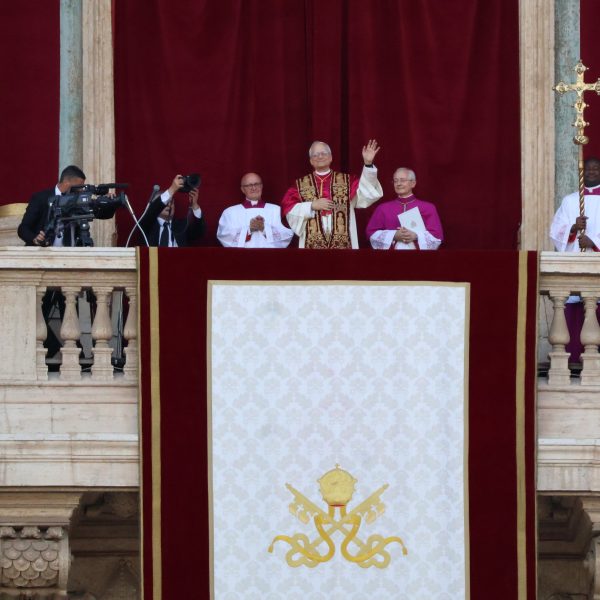
The most surprising target of the President’s ire is Pope Leo. Selected last year to replace the late Pope Francis, Leo is the first ever American pope, and until recently has tried to remain separate from the political sphere, especially in his home country. However, Leo’s commitment to peace and diplomacy has put him at odds with the Trump administration’s more aggressive foreign policy, and the Iran conflict has driven those tensions to a breaking point.
The opening volley
The war of words began with the Pope’s traditional Easter address on the morning of Apr. 5. In his address, Leo implored that “those who have weapons lay them down” and “those who have the power to unleash wars choose peace,” and while he did not mention the current war in Iran directly, his anti-war message was clear.
While the Pope was proclaiming a message of peace, President Trump’s Easter messages were dramatically pro-war. Early on Easter morning, Trump posted a profanity-laced rant on Truth Social, demanding that the Iranian regime “Open the F—in’ Strait [of Hormuz] … or you’ll be living in Hell.” Two days later, on the morning of April 7th, Trump doubled down, claiming that “A whole civilization will die tonight, never to be brought back again” if Iran did not capitulate.
In the ensuing days, Pope Leo continued to position himself as anti-war and criticized world leaders for seeking war rather than diplomacy. When speaking to the leaders of the Chaldean Church (a subset of Middle Eastern Catholics) on April 10th, Leo said that the world was marked by “absurd and inhumane violence,” and argued that the Church must “never [be] on the side of those who yesterday wielded the sword and today launch bombs.”
Though Pope Leo largely avoided discussing Trump by name during this period, journalists did manage to get a more direct answer from him during interviews. When asked about Trump’s threat to annihilate Iran’s civilization, Pope Leo described the comments as “truly unacceptable,” arguing that Trump had violated both international law and basic morals. Other Catholic leaders, including Archbishop Paul Coakley of Oklahoma City, also directly named Trump, with Coakley saying in a statement that he “[calls] on President Trump to step back from the precipice of war and negotiate a just settlement for the sake of peace and before more lives are lost.”
Trump on Truth Social
On the evening of April 12th, Trump turned his attention, and his social media ire, to Pope Leo. He made a 334-word post on Truth Social in which, among other things, he described the Pope as “WEAK on crime and terrible for Foreign Policy,” claimed that priests were getting arrested during the Covid pandemic for holding church services, asserted that Pope Leo would not have become pope had Trump not been president, accused Pope Leo of being an “Obama Sympathizer” and stated that he didn’t want “a Pope who criticizes the President of the United States.” He concluded by saying that Pope Leo’s focus on politics hurts both the Pope and the Catholic Church more broadly. Later that night, he shared an AI-generated image of himself as a Christlike figure, shrouded in golden light and healing a sick man in a hospital bed.
Reactions to these posts were immediate and harsh, especially from the Catholic community. Bishop Robert Barron, a conservative Catholic and member of Trump’s Religious Liberty Commission, described Trump’s remarks as “entirely inappropriate and disrespectful,” while numerous leaders of Catholic-aligned political organizations called on Trump to apologize. When asked about the President’s attacks against him, Pope Leo finally mentioned Trump by name, saying that he has “no fear of the Trump administration, or speaking out loudly of the message of the Gospel.”
J.D. Vance and theological disputes
With tensions rising between Pope and President, observers and journalists turned to Catholic members of the Trump administration, including Vice President JD Vance, to try and ease the tensions. Vance has instead held firm to the Trump administration’s platform, saying on April 14th that the Pope should be more careful when talking about theology and that his claim that God is never on the side of warmongers is historically inaccurate.
Vance has also disputed the Pope’s interpretation of Just War Theory, a Catholic doctrine originating with Saint Augustine that describes when a state can legitimately engage in war. Notably, Pope Leo is a member of the Order of Saint Augustine, and his scholarship primarily centers around Augustine’s thinking and writing. Leo began his current tour of Africa by visiting the city where Augustine lived in the 400s and has discussed Augustine’s views on just war theory (among other things) in his speeches.
Threats of Avignon
While the Trump Administration and the Vatican have been publicly feuding in the last few weeks, there are reports that further tensions between the two parties have occurred in private. On April 6th, The Free Press initially reported that meetings between the U.S. Department of Defense and the Vatican’s representatives had become tense as far back as January of 2026. Further reports have examined the context of those meetings in some detail, with most reporting indicating that the American position effectively argued that the U.S. could do anything it chose and that the Vatican should side with the Trump administration’s choices.
The most concerning part of those reports centers on the allegation that Department of Defense officials had mentioned the Avignon Papacy during their conversations with the Vatican. The Avignon Papacy occurred during the 1300s, when the King of France sent his army to arrest Pope Boniface VIII. After Boniface’s death, the French royals forced the Papal Conclave to elect a French pope, who refused to move to Rome and instead moved the papal court to Avignon, where the French monarchs could directly control both who was elected pope and what the pope could say.If those alleged threats are true, the implications are disturbing. The Avignon Papacy happened when a major world power forced the Catholic Church to obey its demands through military force. It is unlikely that the United States would use military force against the Vatican, but it was enough of a concern that the Pope has canceled his planned visit to the US amid the heightened tensions.