The NASCAR Cup Series completed the first quarter of their season this past Sunday, April 19th. A lot has happened over the first nine races, including a never-before-seen achievement, so let’s do a quick season recap to hit the highlights.
Tyler Reddick keeps winning
Tyler Reddick, driver of the #45 Toyota for 23XI Racing, had a winless 2025 campaign, and with Reddick’s contract expiring at the end of 2026, expectations for this season were somewhat mixed. There were concerns that 23XI was going to take a step back, especially since adding a third full-time car in 2025 had seemingly stretched their resources.
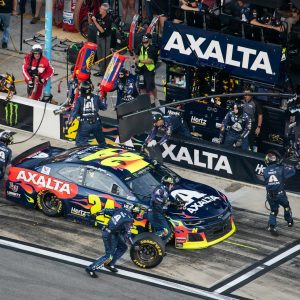
With nine races complete, Reddick has put those concerns, and the rest of the NASCAR field, in the rearview mirror. The #45 car won the season-opening Daytona 500 with help from his teammate Riley Herbst in the #35, before also winning the next two races at Echopark Speedway and Circuit of the Americas. This made Tyler Reddick the first driver in NASCAR history to win the first three consecutive races of a season and earned him and his team owner Michael Jordan (yes, NBA legend Michael Jordan) attention not just from the NASCAR media but from the wider sports media.
Reddick’s winning streak ultimately would end at the next race in Phoenix, but he would click off another win two weeks later at Darlington, and just this last weekend he picked up his fifth win of the season at Kansas Speedway. He currently leads the points standings by 105 points (more than a full race’s worth) over fellow Toyota driver Denny Hamlin. The questions surrounding Reddick and 23XI Racing are now focused on how many more races they can win in the coming months, and how big of a contract renewal Reddick has earned for himself.
Toyota’s dominance
Tyler Reddick may be stealing most of the wins, but Toyota as a whole has had an excellent start to the 2026 season. Besides Reddick’s five wins, two Joe Gibbs Racing Toyotas have also picked up wins. Denny Hamlin, the driver of the #11, defended his race win at Las Vegas, while Ty Gibbs earned his first career win, driving the #54 to victory at Bristol. Hamlin leads the series in laps led (575), while Reddick and Gibbs lead the series in top 10 finishes with seven each.
Toyota teams also are dominating the points standings. Four of the top eight drivers in the standings are in Toyotas (Reddick, Hamlin, Gibbs, and Bubba Wallace, driving the #23 for 23XI Racing). The top 16 in points after 26 races will be eligible for the season championship, and so far, six of the top 16 in points are Toyota drivers, while Ford and Chevrolet each have five. This is despite Toyota only having nine full-time cars, the fewest of any manufacturer (Ford has 10 full-time cars, and Chevrolet has 17).
Ford gains a new top team
Part of Toyota’s dominance can likely be explained by the other manufacturers undergoing significant transitions to start their 2026 campaigns. For the last decade, Ford’s main powerhouse team has been Team Penske, a three-car operation that has won three of the past four NASCAR championships. However, this year Penske’s start to the year has been slower than expected. Ryan Blaney has brought the #12 to victory lane at Phoenix and currently sits third in points, while three-time Cup champion Joey Logano is 14th and Austin Cindric is 17th. Cindric has recovered from a terrible streak of luck, having crashed in the first four races, while Joey Logano has three finishes of 30th or worse, two of which came purely on pace. When they’re fast, the Penske Fords have earned great finishes, but their inconsistency this early on is worrisome.
While Penske has been inconsistent, another Ford team has risen to the occasion. RFK Racing’s three Fords have been the models of consistency, with Brad Keselowski and the #6 sitting 9th in points, Chris Buescher’s #17 car in 11th, and Ryan Preece’s #60 in 13th. Keselowski and Preece both have finished on the lead lap in every race so far, and the team only has two finishes below 20th, one each for Preece and Buescher. None of their cars have shown winning speed so far in a points race (Preece did win the season-opening exhibition Clash), but RFK has proven themselves more than capable of competing on a weekly basis. It remains to be seen whether RFK can one day overtake Penske, but the future of Ford’s NASCAR program looks bright.
Chevy’s early struggles
While Toyota is dominating the season and Ford is gaining a new top-tier team, Chevrolet is having its worst start to the season in decades. The flagship Chevy team, Hendrick Motorsports, only has one win through the first nine races, with Chase Elliott taking the #9 to victory lane at Martinsville. No other Chevy team has looked particularly close to winning, with Spire Motorsports being the only other Chevy team with a car currently in the top 16 in points. Trackhouse Racing, which won six races last season, has been completely off the pace so far, with New Zealand-born Shane van Gisbergen currently their highest-ranked driver at 18th in points. Two-time Cup Series champion Kyle Busch, driving the #8 car for Richard Childress Racing, is currently 27th in points, an all-time career low for him this far into the season.
The cause of Chevy’s troubles is complex, with much of it being due to individual teams performing poorly, Trackhouse and Richard Childress in particular. However, Chevy has debuted a new body design this season, which has made much of their simulator data and performance data irrelevant. The early part of the season may simply become a waiting game while Chevy teams refill their notebooks for the new car body. If Hendrick, Trackhouse, and others continue to struggle into the second half of the season, then there will need to be deeper conversations in the Chevy camp about how to keep up.