Context: Student Projects
Recently, several Jewell students have spearheaded projects critiquing aspects of life on the Hill and calling for change. In the last few years, we saw students challenge William Jewell College’s whitewashing of the history of campus buildings with the Slavery, Memory, and Justice project (SMJP), which eventually culminated in Jewell’s gesture of racial reconciliation and an examination of the role of slavery in Jewell’s past. Currently, Jewell is undergoing a lot of changes as a result of the recent declaration of financial exigency, and students have stepped up to demand openness throughout this process as well.
The focus of this article, however, is even more recent. Last semester, a group of students presented their findings of racial bias in the dorm lottery process, as well as detailing inadequate living conditions, particularly in Browning Hall. One of those students, Jacob Tetlow, has worked as an RA in Melrose Hall for several semesters. During this semester’s Duke Colloquium, he co-presented a further project about the Jewell experience, mentioning specific ways students’ lives could be improved by the college’s administration.
This project was presented as a set with Mason Sullivan’s Black Freedom Struggle Symposium documentary, which addressed similar themes. While Mason highlighted the ability of Jewell’s small size to produce a tight-knit community, the stellar faculty we have the privilege of learning with, and the excellent academics, he found that Jewell has a need for more diversity and cultural knowledge within the student body. “I think in order for Jewell’s administration to improve on their recruitment practices and acknowledgement of different cultural groups they need to do more to have other cultures feel accepted on campus,” Mason stated in an interview with the Hilltop Monitor. “Recruiting students from different backgrounds is a good place to start, and over my last four years here I have been seeing major improvements in the amount of diversity I see on campus.”
While the documentary maintains a mostly upbeat tone, Mason does acknowledge that it is “[a glimpse] into the reality of the school, not just what gets advertised, and … a critique and a call to action for administrators to see how the students feel on certain things and what that means for the future of the college.” As Jewell goes through changes, students have consistently stepped up to share their opinions and insights with administration, and call leadership to action on certain issues that affect the student body but may not be felt by higher-ups. Students often put themselves in a tenuous position by calling out the institution at which they are studying, so it is extremely important to maintain an accepting environment during this process.
For the most part, Jewell has provided that accepting environment. Mason Sullivan noted that the response to his project was overwhelmingly positive, and that “the president of the college [then-interim president Susan Chambers] at that time came up to [him] afterwards to tell [him] how much she enjoyed it and asked what she could do to help” after his first presentation of the documentary at the Black Freedom Struggle Symposium. Mason also told the Monitor that Jewell faculty, staff, and students were nothing but supportive, expressing gratitude “for the support I got from faculty like Dr. Howard, [College chaplain] Rev. Dowling, and [admissions counselor] Will Palmer who were adamant to get this story to the people who needed to see it.”
Jacob Tetlow also recalls that “everybody that I’ve interacted with on the admin side that has talked to me about the presentation, it’s been like what you’d expect from critical thinking college,” denying that he faced difficulties from the college during the research and presentation process. However, academic freedom concerns have surfaced, especially within Jacob’s RA role and his ties to Student Life.
Mistakes Made, Mistakes Corrected
On Apr. 17, the Student Life department informed Melrose RA Jacob Tetlow that he would not be returning to his position for the 2026-2027 school year.
When he scheduled an Apr. 22 meeting with Student Life asking why he was removed from his position, Student Life, represented by Greek Life coordinator Ryan West and Assistant Dean of Students Jennifer Herzog, originally gave two reasons. The first was that he had been too lenient regarding “room switching” in Melrose. Melrose is the only suite-style dorm not part of Greek row. Jacob told the Hilltop Monitor that “[t]o get into Melrose, you have to apply to be in a lottery, and these people wanted specific roommates and stuff, and so they just wanted to ensure that their team could make it into Melrose and then they sorted it amongst themselves afterwards.” Since Tetlow did not have the authority to unilaterally switch student rooms, he told the students that they needed to talk to Student Life. Tetlow confirms that this incident was not brought up to him until the meeting in which he was let go.
The second was that Student Life believed Tetlow had not followed the proper “chain of command” on the Browning Project he conducted last year. The project uncovered evidence of racial disparities in Jewell housing; the percentage of Black students living in Browning Hall, seen as one of the worst-quality dorms by residential students, was substantially higher than other dorms. (According to project data, about 30% of Browning residents are Black, compared with approximately 10% in Mathes, Eaton, Melrose, and Jones.) As part of the project, the team interviewed then-Dean of Students Ernie Stufflebean, Vice President of Marketing, Enrollment and Student Life Eric Blair, and others to obtain critical residential data for use in their project.
According to Tetlow, Student Life stated that the project’s results made some College employees uneasy; Tetlow claimed that “[they] didn’t tell me who else, but [a Student Life staff member] did say that other people were made uncomfortable by that presentation that we gave, and it pushed buttons.” In a request for comment, College administrators confirmed to the Hilltop Monitor that “it was reported to leadership that a staff member’s personal opinion or response to Jacob’s research was shared and influenced decision-making to some extent.”
YikYak exploded with the news, to the point that peers in classes were asking about what was going on. On the night of April 21—twelve hours before Tetlow and colleagues presented a different documentary about campus community at Duke Colloquium—Jacob received a text from Eric Blair asking to meet with himself, President Drew Van Horn, and the Vice President for Academic Affairs (VPAA) Keli Braitman, who was present to resolve concerns about academic freedom. The meeting took place at noon on Duke Colloquium, and in it Tetlow was offered his position back.
College administrators told the Hilltop Monitor that “In consultation with the President, Dr. Van Horn, VPAA, Dr. Braitman, and VPEM, Mr. Blair, Assistant Dean of Students and Director of Residence Life, Ms. Jennifer Herzog invited Jacob to stay on staff. Dr. Van Horn, Dr. Braitman, and Mr. Blair met with Jacob and a faculty advisor [who Jacob confirmed was Dr. Groninger in History] to discuss the circumstances and to assure him of his place on staff.” Dr. Braitman, vice president for academic affairs, told Jacob of her concerns that the incident represented “a violation of [his] academic integrity, and that’s one of the reasons we want to rectify it.”
Tetlow noted that he was “fired and reinstated” within the span of a week, suggesting that the College immediately recognized its error and reversed course.
Next Steps: Student Advocacy
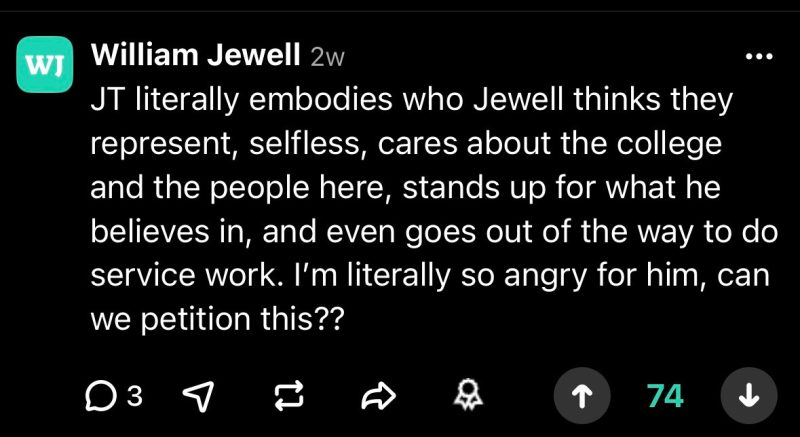
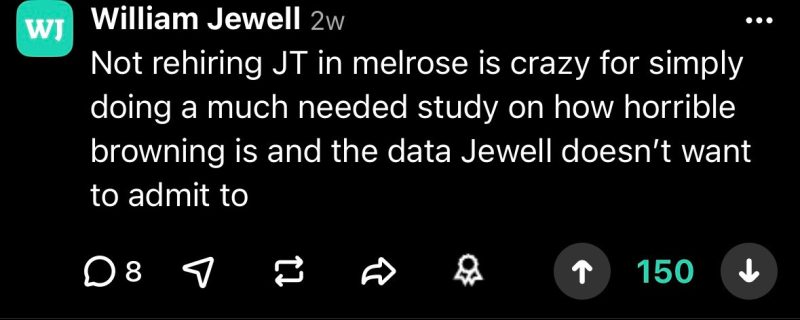
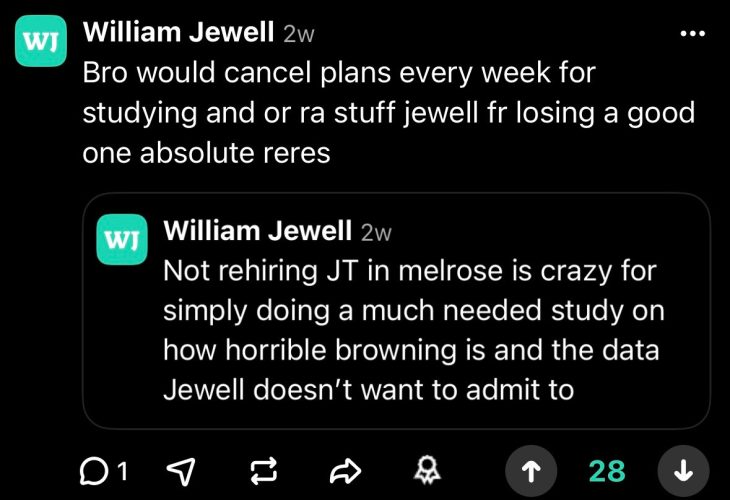
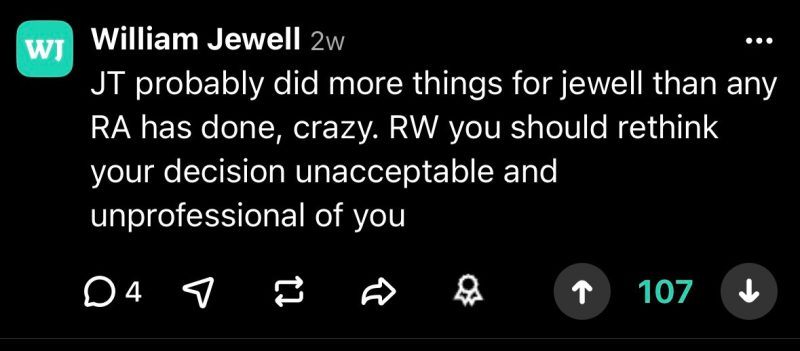
Posts on YikYak, the anonymous campuswide social media app, were overwhelmingly supportive of Jacob and critical of the college’s decision not to rehire him as an RA. The anonymous users described him as caring, selfless and deeply committed to students. One post argued that not rehiring Jacob (JT)1 over his study was “crazy” and accused the school of avoiding uncomfortable data. One user wrote that “[Tetlow] literally embodies who Jewell thinks they represent,” praising his service work, leadership and willingness to stand up for his beliefs. Another called him “the best RA I’ve ever had” and said he was being punished for “being a voice for the people.”One post claimed he had “done more things for Jewell than any RA has done.”
According to Jacob the YikYak reaction changed everything. “The reason that, like, I think I got this meeting … is because [of] the YikYak stuff,” he said in an interview.


The Aftermath: Academic Freedom At Jewell
This incident on its own has some disconcerting implications. However, this is not the only incident in recent Jewell memory in which the college has reacted negatively to a research organization investigating race relations on William Jewell’s campus. Back in 2020, a group of students at Jewell formed what they called the Slavery, Memory, and Justice Project (SMJP), which sought to explore the history of slavery in Clay County and how slavery shaped the early days of the college. This group, led by then-professor Dr. Christopher Wilkins, performed a deep scholarly exploration of the historical record, highlighting the lives of slaves in the community that surrounded Jewell’s campus and the pro-slavery views of Alexander Doniphan and other key figures in Jewell’s history. The SMJP received significant media and academic attention, with both the Hilltop Monitor and other KC-area news organizations discussing the SMJP’s efforts.
What made the SMJP’s work even more noteworthy is how little institutional support the SMJP had at the college. The SMJP’s official website, and many of the articles written about their work, highlight an extensive list of allegations that college leadership systematically restricted the ability of SMJP students to conduct research and discredited their work. The Pitch KC’s article on the subject portrays the relationship between the institution and the SMJP as tense, describing how the college refused to invite Dr. Wilkins or SMJP members to key meetings, refused to let the SMJP use the college archives, and used some of the SMJP’s findings without proper credit in their own historical accounts. The Pitch’s article further includes an email, sent by then-president Elizabeth MacLeod Walls, in which she asserted that “it is the sole responsibility of the Commission [a College-affiliated research team] to determine what is true.”
After the controversy surrounding the SMJP, Jewell created two key task forces to explore what happened between the SMJP and the college and to examine academic freedom policy at Jewell more broadly. The first was a special assignment for the Faculty Council, who were tasked with exploring the specific violations of academic freedom alleged by the SMJP. The second was the Student Academic Freedom Task Force to examine the state of academic freedom at Jewell and create a list of proposals for improving Jewell’s policies as regards student research. The student task force, which operated for around a month at the end of the 2022-2023 academic year, produced a list of proposals for amending Jewell’s policy library.
While both of these groups generated their own conclusions on the question of academic freedom at Jewell and shared their conclusions with college administration, none of their conclusions were ever released publicly despite requests by the Hilltop Monitor and other student organizations. It is therefore unclear if any of their recommendations were actually adopted by the college or not.
The SMJP’s case is troubling, but it is important to remember that the college’s leadership has changed substantially since 2022, and the administration’s response to the current incident has been more promising. In their comments to the Monitor, College administrators emphasized that policy changes would result from this incident. When asked what the administration learned from the incident, Dr. Van Horn told the Monitor that
In my seventeen years as a college President, I have learned that there are best practices that every college should follow. In my eight months as interim president at Jewell, I have noted that many of these best practices were not in place. I have directed these practices to be implemented at Jewell. First and foremost is the training of faculty and staff regarding behavior expectations for all Jewell employees. Thus, we are beginning a significant annual training program that all employees must complete. When an employee violates one of these expectations, we intervene, educate, and, if necessary, take corrective action. In short, the administration has learned that it has not done a good job of educating employees of these expectations and intervening as soon as possible when one has been violated. (emphasis added)
The administration’s willingness to reinstate Jacob as an RA is a good sign that college leadership is more concerned about academic freedom and research at Jewell than they have been previously. While Jewell still has work to do in order to rebuild students’ trust in their handling of academic freedom concerns, the administration’s immediate and unequivocal decision to reinstate Jacob is certainly a step in the right direction.
Conclusions
Thankfully, this incident has a happy ending. Jewell students and faculty, when we band together, have significant power to cause change, even in administrative decisions which we often think of as disconnected from the student body. In an interview, Jacob Tetlow recalled that one of the main reasons the VPAA cited for reinstating him was that it seemed like he was “wanted as an RA here outside of just that one individual’s decision.” He also noted conversations in his classes that led to student advocacy on his behalf, specifically highlighting support from peer Sara Polovina and professor Dr. Gary Armstrong. This in-person advocacy, as well as online advocacy via YikYak, influenced the decision to bring Jacob back as an RA next year. Jacob went on to say that
I think, you know, it is that advocation from so many people around Jewell, so many people saying that’s uncomfortable, I don’t feel comfortable with that, that’s not right. This school has been pushing us for a long time, it seems like now, and we’re not gonna let them push past the fundamental values that built this school. […] I think that’s what enraged and embroiled a lot of people to actually do something.
We hope Jewell listens to student concerns and continues to take academic freedom seriously in the future. For example, the Student Life department itself is not well funded and is experiencing a lot of staff turnover. Jacob noted within the interview that “Student Life has really been trying, especially since Ryan got there, to kind of be the unit in the admin that melds … cliques, that provides an opportunity for people to meet together as a group and build a community outside their individual interests. And I think that Ryan is really, really trying hard for that. And I don’t know if she’s necessarily fully supported. And now that we’re losing a lot of RAs, she’s definitely … going to be less supported next year.”
While student advocacy still has a long way to go, we have hope that college administration will continue to act quickly and address student concerns, protecting academic freedom and providing a safe space for Jewell students to express their thoughts about their college experience.
“We’re not just going to be able to solve it overnight, if we’re going to be able to solve it at all without tearing something to the ground, like a building. For my part in the presentation and in the documentary, I really wanted to provide a framing where people could actively do stuff to make that thing better. And really, it boiled down to just being able to see, you know, it sounds corny, but like your classmates having fun and smiling around campus and it’s like, okay, well, I want to go and do that too.” – Jacob
- YikYak does not permit names on its platform; instead, all references to names must use the individual’s initials. ↩︎
