Editor’s note (competing interest): The author of this article is a member of the Oxbridge Honors Program.
The end of the 2025-2026 academic year will mark the end of William Jewell College’s Oxbridge Honors Program. The program was already barely clinging on, with admissions for new students closing in 2025 and the unique small-group tutorial-style courses that defined the program being eliminated that same year. The college’s financial exigency has also resulted in significant faculty turnover, including the loss of many Oxbridge professors. The current Oxbridge Senior Tutor and the final remaining Philosophy professor at Jewell, Dr. Elizabeth Sperry, is among that list, as she has been let go by Jewell after over 30 years at the college.
While the average Jewell student had little interaction with the Oxbridge program, for those students (including myself) who were fortunate enough to be selected for it, the program was truly a life-changing opportunity. With the program officially being closed by the college this year, I’ve taken some time to reflect on just what Oxbridge has meant for me. The Oxbridge Honors Program deserves to be remembered, and the lessons of its closure must be understood if we wish to preserve what makes Jewell unique.
Why Oxbridge Mattered
The Oxbridge Honors Program was much more than just a typical honors program. Oxbridge students were offered a thoroughly specialized and highly intensive form of education, one that didn’t fit into the standard structure of Jewell so much as was added on top. In their first semester, Oxbridgers would take the Introductory Seminar, an intense crash course on writing and thinking philosophically. Even now, at the conclusion of my senior year, the Oxbridge Intro Seminar remains arguably the most influential single course I have taken in my time at the college, and my experiences there continue to shape how I read, write, think, and live.
After completing that first seminar, each of the six Oxbridge majors would proceed into a planned-out list of specialized tutorials, a specialized and Oxbridge-exclusive class with a Jewell professor who specialized in that given subject. Every week, there would be an assigned list of readings from key thinkers and researchers in that field, and most weeks would include an essay assignment about that given reading. During the course meeting, the students would share their essays and would have to defend their ideas before their professor and their fellow students. These opportunities to not only write down my arguments about a given question but to defend them under often-intense scrutiny have been incredible for developing my ability to reason on the fly.
The pre-planned structure also permits Oxbridgers in the same major to develop a close academic camaraderie. For cases where multiple Oxbridgers share the same year and major, those students take all their tutorials together, letting them build rapport over time and become comfortable sharing their ideas and critiquing each other. The students I’ve shared tutorials with have greatly shaped my thinking on many key questions in the field and learning not just alongside them but also from them is an incredible feature of the program.
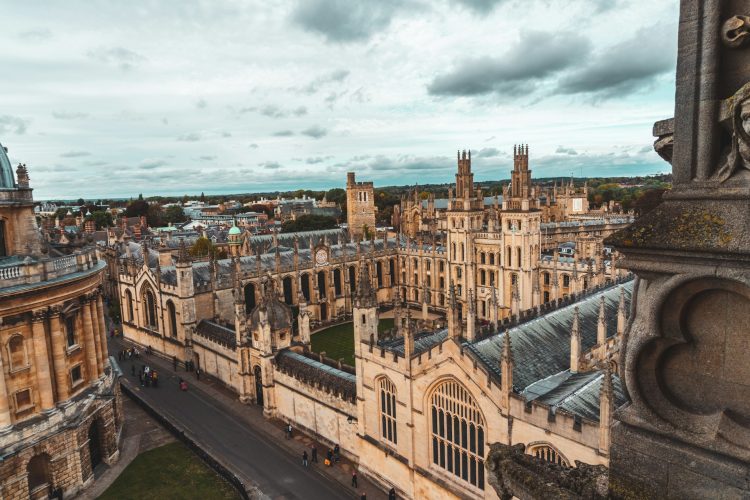
While Oxbridge provides students with many wonderful opportunities during their years on Jewell’s campus, the distinctive feature of the program was the study abroad opportunity in the junior year. As the name implies, the program primarily sent students to Oxford University, allowing students to join one of the oldest and most academically rigorous institutions on the planet.Jewell maintained relationships with eight Oxford colleges (Regents’ Park, Mansfield, Hertford, Lady Margaret Hall, St. Anne’s, St. Catherine’s, St. Edmund’s, and St. Peters’), and Oxbridge students could select from any of the options based on their interests, major, and location preferences.
I cannot speak for every Oxbridge student, but for me, that year abroad was the greatest highlight of my time in the program. It not only helped me grow academically but showed me a new way of learning and a new way of life. Before that year, I would never have considered moving to a new continent, but spending a year in Oxford proved to me that I want the next stage of my academic career, and of my life, to be in Europe. Without Oxbridge and the opportunities Jewell provided, I would never have found that next step forward.
What Went Wrong
Like all good things, the Oxbridge Program didn’t last forever. Identifying an exact date of its demise is tricky, but this year, in which the college officially informed students and faculty that Oxbridge would be closed and the role of Senior Tutor eliminated, is as good a date to select as any. The actual causes of its closure are various and complex; Oxbridge was a remarkable and unique program but by its nature it placed a huge number of financial and logistical challenges on the institution. Jewell is already suffering through a crisis wholly unrelated to Oxbridge, and the college’s reactions to that crisis have largely shifted its focus away from its more specialized programs; with all those institutional headwinds facing the program, its removal is sadly unsurprising.
The start of Oxbridge’s downfall was the loss of the Hall Family Foundation’s grant. The Hall Family Foundation, built from the fortune of the founders of Hallmark Cards, spent millions of dollars on the Oxbridge program, with their 2014 report listing a grant of over $1.2 million specifically to assist with program expansion between 2014 and 2017. These grants helped fund not only scholarships for Oxbridge students but also the Journey Grants that helped Oxbridgers fund their study abroad year in Oxford.
Unfortunately, this money, initially donated shortly after the program’s founding in 1982, has since run dry, and has left the Oxbridge program financially unsustainable. While Dr. Sperry made significant efforts to reinforce the financial position of the program through fundraising efforts, her efforts came at the same time as the College’s major fundraising push for the now-abandoned Link project, and later during the financial exigency. As such, Jewell did not prioritize the Oxbridge fundraising efforts, and without a significant benefactor for the program, Jewell was unable to continue providing the Oxbridge Journey Grants and other scholarships. This, along with the rising cost of an Oxford education in the first place (visiting student fees increased 34% between academic years 2019 and 2023), has significantly reduced the ability of the remaining Oxbridge classes to enjoy the program’s key distinctive feature.
The financial exigency at Jewell has impacted not only the funding of Oxbridge but also the educational experience of Oxbridge students at Jewell. As explored in the Hilltop Monitor back in spring of 2025, 45 faculty and staff members, including tenured faculty, were laid off during the initial declaration of exigency, and additional faculty members, including Dr. Sperry, will be leaving at the end of this academic year. The Oxbridge program’s tutorial system relied on having faculty available to teach those unique one-of-a-kind classes, and with the downsizing of Jewell’s faculty, there simply were not enough faculty members available to teach those tutorials.
As such, starting with the 2024/2025 academic year, Oxbridge tutorials were turned into “embedded tutorials,” where students would participate in a regular class and would meet occasionally with their professor on the side, either during office hours or at a scheduled meeting. These embedded tutorials did not count as an additional course on a professor’s workload, since the primary class meeting time was shared with another non-Oxbridge course, which meant that professors could be scheduled for their full course load and be required to teach an Oxbridge course in addition. This stopgap measure was functional enough for Oxbridge students, and the embedded tutorials I have taken at Jewell have certainly been enjoyable. However, the additional workload placed on professors added extra stress onto faculty members who had already been pushed to their limits.
With Jewell downsizing their professorial staff even further at the end of this academic year, and with the college currently working on their Reimagined Jewell restructuring plan, maintaining even the reduced vision of Oxbridge became incredibly untenable. With Jewell’s emphasis on “developing a flexible, adaptable curriculum” in the wake of their current challenges, the Oxbridge program, with its clearly defined four-year tutorial structure and closed cohorts, would become more of a hindrance than a benefit. Other unique programs, including Jewell Theatre and the Honors Institute for Critical Thinking, have also been casualties of Jewell’s restructuring, and it’s likely that an emphasis on flexibility and broad appeal was part of the decision to cut those programs as well as Oxbridge.
While the loss of Oxbridge may have been inevitable under the current pressures facing the college, that does not make its loss less sad. Oxbridge was not just an honors program that served a few students per year, it was a core aspect of the variety and the excellence that has made this college special. The loss of Oxbridge shows a Jewell that has given up on that which once made it unique, and whatever the future of the college may hold, those unique and meaningful programs should, and will, be missed.
WJC has had many rough days in recent years, but the end of Oxbridge is exceptionally sad.
I’m old enough to remember when it seemed normal to turn down merit scholarships from more selective colleges to pursue Oxbridge on the hilltop. I know no one who made that choice who ever second-guessed their choice. Nor did any ever contemplate a Jewell without Oxbridge.
I think the inescapable reality is that the Hall family lost confidence in Jewell leadership, and it’s hard to blame them, despite the best efforts of those in charge today. Midwestern politeness will keep them from ever acknowledging that formally, but the foundation is not in sunset mode. It takes decades to earn the confidence needed to secure those type of donations, but that confidence can be lost much more quickly.
Thank you for this much-needed commentary on your experience. You will be a Jewell alum the rest of your days and I hope you never stop reminding folks just how special Oxbridge was. Maybe you can be part of creating something like it when the time is right.